17 December 2025

Sandhan Valley, often called the “Valley of Shadows

Sandhan Valley, often called the “Valley of Shadows”, is a unique natural gorge located in the Sahyadri (Western Ghats) near Samrad village, Akole taluka, Ahmednagar (Ahilyanagar) district, Maharashtra.


Sandhan Valley, also known as the Valley of Shadows or Valley of Suspense, is a breathtaking water-carved canyon located in the Sahyadri Western Ghats of Maharashtra, India, near the village of Samrad in the Bhandardara region. The valley is approximately 200 feet deep and stretches about 1.5 to 2.5 kilometers in length, with some sections narrowing to less than 3 feet, creating an environment where sunlight rarely reaches the ground, giving it its mystical name. It is surrounded by prominent mountain ranges, including Alang, Madan, Kulang (AMK), Ratangad, Ajoba, and Kalsubai—the highest peak in Maharashtra at 5,400 feet. The trek to Sandhan Valley typically takes 5 hours and involves challenging terrain such as narrow gorges, rocky patches, water crossings, and rappelling at multiple points, requiring experienced guides and proper gear. The best time to visit is from October to May, with the post-monsoon season offering pleasant weather and moderate water levels ideal for trekking. The valley is accessible year-round except during the monsoon season, and while entry is free, organized treks with camping and rappelling are commonly led by adventure tour operators

Harishchandragad Fort – History

 Harishchandragad is one of the oldest hill forts in Maharashtra, located in the Western Ghats (Sahyadri range) in Akole taluka, Ahmednagar (Ahilyanagar) district. It stands at an altitude of about 1,424 meters (4,670 ft).


At a distance of 8 km from Khireshwar, 50 km from Bhandardara, 166 km from Pune & 218 km from Mumbai, Harishchandragad is a historical hill fort situated in Ahmednagar district of Maharashtra. Situated at an altitude of 1,424 m, the fort once played a major role in guarding and controlling the surrounding region. Harishchandragad is very popular place for trekking in Maharashtra and also one of the famous Bhandardara tourist places.

The fort originally dates back to the 6th century during the rule of Kalchuri dynasty. The citadel was built during this era and various caves probably have been carved out in the 11th century AD. Sage Changdev used to meditate here in 14th century AD. Later the fort was under the control of Mughals and Marathas captured it in 1747 AD. Remnants of Microlithic human inhabitants have been discovered here. The various Puranas like Matsyapurana, Agnipurana and Skandapurana have many references about Harishchandragad.

Rohidas, Taramati and Harishchandra are the three peaks in Harishchandragad. Taramati peak is the highest peak in the fort and provides a beautiful panoramic view of the nearby surroundings and the forest area. Many peaks and attractions like Malshej Ghat, Jivdhan, Nane Ghat, Ratangad & Kalsubai can also be seen from here. Konkan Kada or the Konkan cliff is a semi-circular rock wall and resembles a Cobra's hood. Apart from trekking opportunities, this fort has lot of temples and caves within the premises. The fort has a carved Lord Vishnu Temple with many idols and is believed to have been constructed by the Kalchuri dynasty.

Kedareshwar cave is a unique cave which is located on the way to the Harishchandreshwar temple. It is an abode to five feet-tall Shiva linga, surrounded by four pillars, in a pool of water. There are a few other temples including Nageshwar temple and Harishchandreshwar temple in this area. The Buddhist Caves near the fort are other prominent attractions.

There are 3 popular trekking trails to reach the fort - via Khireshwar Village, via Nalichi Vaat and the easiest one via Paachnai village. The trek route from Khireshwar village is a straight trail that goes towards Tolar Khind and it takes 2 to 2.5 hours one way. After Tolar Khind, there is a 100 feet rock patch, which has iron railings for the safety of trekkers. After crossing rock patch a straight way leads to Harishchandreshwar Temple with small hills & streams in between.

There is another way to reach Harischandragad from Paachnai village, which is 48 km away from Bhandardara. One needs to do 5 km trek from Paachnai to reach Harishchandragad. The trekking path is easy and beautiful as one can enjoy the natural beauty of forest. It takes approximately 3 hours to reach to the top of Harischandragad. There are many rocky patches and steep climbs enroute.

The third path is specially meant for hikers, which starts from Belpada village via Sadhleghat. From here, the route goes through Sadhleghat and is extremely difficult. Here one has to climb a straight rock patch on which grips are provided. The trail from here is uphill and continues to remain rocky. It takes 9 hours to reach the fort (on way) and the total distance is about 19 km from Belpada village. Camping is allowed on the peak.


 Kalsubai Peak, standing at 1,646 meters (5,400 feet), is the highest peak in Maharashtra. It is located in the Western Ghats (Sahyadri range) near Bhandardara, in Akole taluka of Ahmednagar (Ahilyanagar) district.


 Peak is named after a local Koli girl named Kalsu, who is central to the mountain's legend. According to the story, Kalsu worked for a Koli family under the condition that she would not be required to clean pots or sweep. When she was ordered to do so, she complied but then climbed the hill and remained there until her death, seeking freedom from her duties. The places where she performed these tasks are known as Thale Mel (where she cleaned pots) and Kaldara (where she cleared litter).

The peak holds religious significance, with a temple dedicated to Goddess Kalsubai at its summit, believed to have been built in her honor after her disappearance. This temple is a place of worship, especially during the Navratri festival, when special prayers and celebrations are held. The mountain is also associated with historical importance, having been used for surveillance during the Maratha rule due to its commanding view of surrounding forts and the Bhandardara Dam.


Bhandardara Lake

 Bhandardara Lake, also known as Arthur Lake, is a man-made reservoir in Ahmednagar (Ahilyanagar) district, Maharashtra. Its history is closely linked to British-era water management projects.


Bhandardara Lake, also known as Arthur Lake or Lake Arthur Hill, is a horseshoe-shaped reservoir formed by the construction of the Wilson Dam on the Pravara River in the Ahmednagar district of Maharashtra, India. The dam, built in 1910 by the British, is one of the oldest earthen dams in India and serves as a key source of irrigation and hydroelectric power. The lake is surrounded by lush green forests and rolling hills of the Sahyadri mountain range, creating a serene and picturesque environment ideal for boating, camping, and picnics.

The lake is a central attraction in Bhandardara, a popular hill station known for its natural beauty, biodiversity, and adventure opportunities. It is particularly renowned during the monsoon and post-monsoon seasons (June to February), when the water level rises, waterfalls come alive, and the surrounding landscape turns lush green. The lake is also a key site for observing fireflies during their mating season, although tourism during this period can disrupt their natural behavior.

Visitors can enjoy various activities at Bhandardara Lake, including boating, fishing, and evening strolls along the lakeside. The area is also a gateway to several other attractions, such as the Umbrella Falls, which is visible from July to October when the dam overflows, and Randha Falls, a 170-foot waterfall located about 10 kilometers away. The highest peak in Maharashtra, Mount Kalsubai at 1,646 meters, is accessible via a trek starting from nearby Bari Village, offering panoramic views of the region


Rehekuri Blackbuck Sanctuary Maharashtra

 Here’s an overview of the history and background of the Rehekuri Blackbuck Sanctuary in Ahmednagar district, Maharashtra:


Blackbucks, also known as Indian antelope, is famous all over India for of its unique jump and being the sole extant member of the genus Antilope. In India, only four picturesque wildlife sanctuaries were made to preserve the number of blackbucks and the most beautiful amongst them with the highest chances of spotting them (blackbuck) is Rehekuri Blackbuck Sanctuary. In Maharashtra, blackbucks are seen only in Rehekuri Wildlife Sanctuary. Initially, when the wildlife sanctuary was formed, the population of blackbuck was hardly 15. And to one's astonishment, the current no of blackbucks are 400. Blackbucks in Maharashtra are referred as 'kalvit' and the male blackbuck easily stands out from among a group of antelopes for its long spiral horns roaming in the grasslands.

The tradition of protecting the blackbucks has been going on in full swing since the rule of Bishnois of Rajasthan. Though the park is small in size as compared others, hardly 2.17 square kilometers, but it provides interesting exploration trails. Apart from the blackbucks, here one can spot chinkaras, wolves, and the Indian fox too. Trekking is the best way take a stock of the sanctuary. And if tourists have extra time at their disposal, then they should visit Lord Ganesh temple and Rashin Devi temple.


Siddheshwar Temple(s) in Ahmednagar

 Here’s a history and overview of the Siddheshwar Temple(s) in Ahmednagar district, Maharashtra — because there are multiple Shiva temples named Siddheshwar in the region with distinct historical backgrounds:


The Siddheshwar Temple in Solapur, Maharashtra, dates back to the 12th century, when it was founded by the revered saint Shri Siddharameshwar, a disciple of Shri Mallikarjuna of Srisailam. According to legend, the saint had a vision instructing him to install 68 Shiva Lingams across Solapur, with the temple at the center as a sanctum of divine power, aiming to bridge the spiritual divide between followers of Lord Shiva and Lord Vishnu. Shri Siddharameshwar, a key figure in the propagation of Lingayatism, attained Jeeva Samadhi within the temple complex, making it a site of significant spiritual importance.

Another Siddheshvar Temple is located in Rajgurunagar, near Pune, which was built on March 4, 1725 CE, by Trimbaka Śeth, an ancestor of resident Kāśikara Madhve. The construction of the Bhāgīrathī Kuṇḍa (Puṣkaraṇī) in front of the temple was completed on October 12, 1735 CE. This temple complex includes a traditional Maratha stepped well, Dharmaśālās, Tulasī Vṛndāvana, and several shrines, with inscriptions providing historical details about its construction and patrons.

In Akole, the Siddheshwar Temple is believed to have been built during the 5th century AD on the bank of the Pravara River during the rule of the Shilahara family. The temple was buried under river deposits until the 18th century and was later excavated and restored, with one of the mukhmandapas reconstructed in the later Peshwa period style. This temple is notable for its unique features, including a floor made of cow dung and rare camel sculptures in the temple carvings.

In Talegaon-Dhamdhere, the Siddheśvara Temple was constructed on March 16, 1732 CE, by Mora Sheti Karanje and his relatives, who were moneylenders of the Peśvās. The temple complex includes a gūḍhamaṇḍapa, antarāḷa, and garbhagṛha, with a Sanskrit inscription detailing its construction. The temple is part of a larger complex that includes other significant temples and historical remains, reflecting its importance in the region.

Additionally, the Amruteshwar Siddheshwar Temple Complex in Pune includes a Siddheshwar Temple built in 1738, dedicated to Guru Dakshina, and other temples constructed in the 17th and 18th centuries. The complex features an underground shrine and has undergone various restorations over time

Farah Bagh

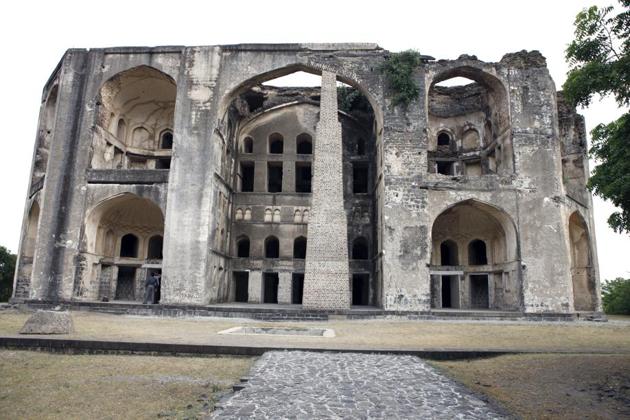
 Farah Bagh is an important historical Mughal garden complex located near Ahmednagar (Ahilyanagar), Maharashtra, India.


Archaeologists studying Farah Baug, a 16th-century summer palace of the Ahmednagar sultanate, have found that the building used a unique lime technology that kept those staying there cool in the blistering Deccan summer.

Farah Baug is a 16th-century summer palace of the Ahmednagar sultanate.(HT Photo)

Also called Farah Baksh Bagh or Faria Bagh, it was built in 1583 by the Nizam Shah rulers, and sits at the centre of a huge palace complex. Delhi-based National Museum Institute (NMI) of the History of Art, Conservation and Museology, and the Archaeological Survey of India (ASI), Chennai, which analysed material used in the palace’s construction, found that its 13-cm-thick lime plaster was embedded with stone, fired pottery and brick pieces that may have improved its permeability. Sand, jute fibre and dry paddy stem increased porosity, durability and flexibility, helping the plaster absorb moisture from the surrounding water fountains. In the summer heat, the moisture escaped slowly through the plaster, cooling the interiors. The natural cooling technique, said MR Singh, lead author and professor, department of conservation, NMI, kept temperatures inside the building 8-12 degrees Celsius lower than the 46 to 48 degrees Celsius that the region experiences between March and June.

The study ‘Architectural features and characterisation of 16th century Indian Monument Farah Bagh, Ahmed Nagar, India’, was published in the International Journal of Architectural Heritage on May 8.

“Lime plaster and potsherds, which absorb water 300% more than their volume, exhibited almost the same porosity. The high open porosity of air lime and the ability of potsherds to hold moisture contributed towards the exchange of moisture from the underlying materials without causing any functional instability,” said Singh. “Instead, the embedded potsherds provided mechanical strength to the plaster and helped in its survival.”

The high percentage of air pores in the plaster mix also contributed to the diffusion of moisture from the underlying building materials. Researchers said the construction technology of Farah Baug is rare, unlike palaces in India that used wind to cool to interiors.

“The architectural form, the building location, the context of large pools of water around it, and the vegetation that it was set in, are the major factors that would shape temperature,” said Pushkar Sohoni, cultural historian and assistant professor, Indian Institute of Science Education and Research, Pune, who was not involved in the study.